Case Study
Warehouse opening hours instead of Excel — how a small app replaced a shadow process
A case study from Zalando logistics: opening hours of warehouse locations were maintained in Excel and passed around. A compact web app turned this into a reliable process — with central maintenance, clean interfaces and built-in access control.
Context
Zalando Logistics
Stack
Kotlin · Spring Boot · React · OPA
Result
One central app instead of Excel sheets
The problem
When is which warehouse open, when closed, when do special hours apply? Many parties in a logistics operation need this information: operational teams, planning, neighbouring systems.
The hours were maintained in Excel sheets. What began as a pragmatic solution became more error-prone with every location: files were passed around, it was unclear which version was current — and who was allowed to make changes was not technically enforced anywhere.
A classic shadow process: business-relevant data in a spreadsheet that was never meant for it.
The solution
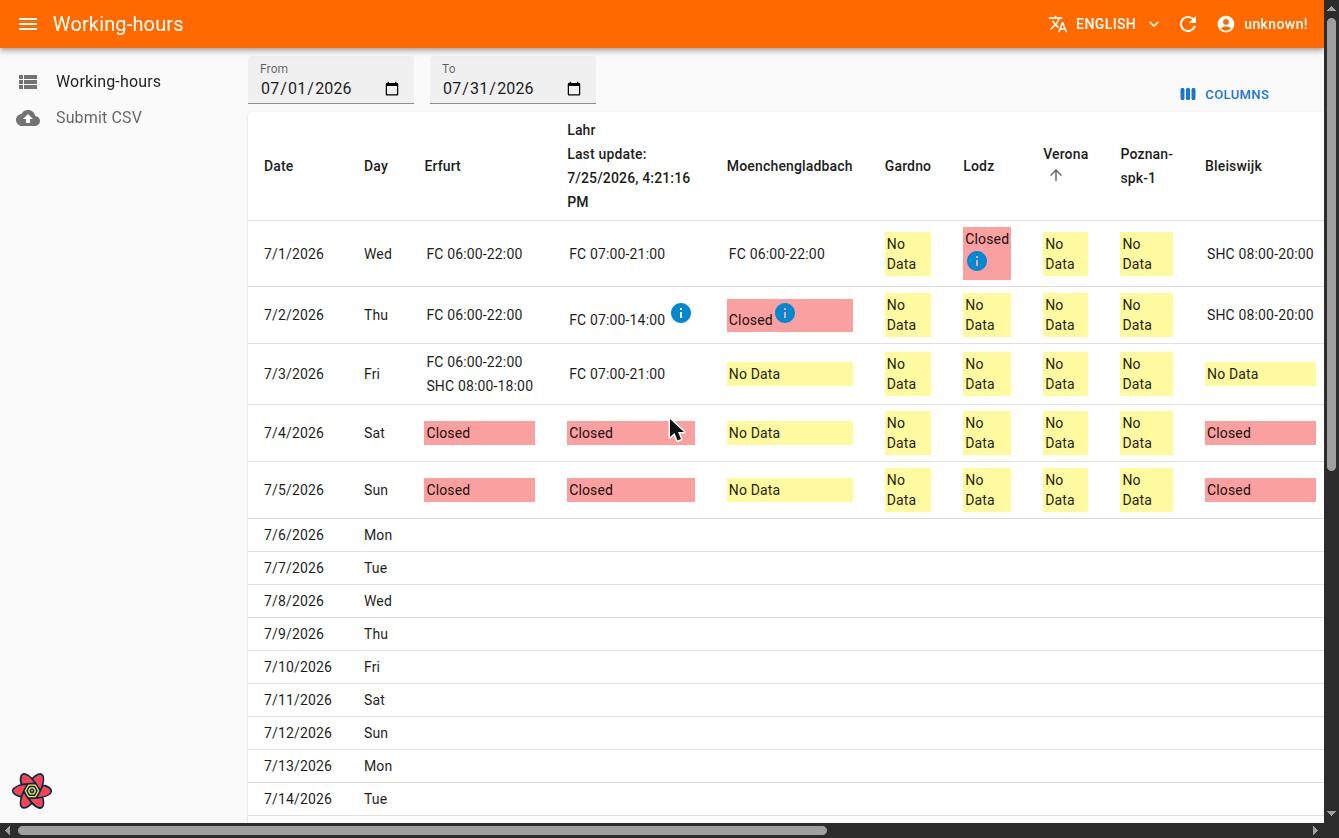
A compact web app replaced the sheets: a backend with REST APIs as the reliable source for all systems that need the hours, and a UI where the hours are maintained directly per location.
For the transition there was a CSV import — existing spreadsheets could be taken over directly instead of re-entering everything.
Security by design
Not everyone may change the hours of every location. The app was built accordingly from the start: authentication via OAuth2, fine-grained authorization with Open Policy Agent (OPA). Who can see and maintain which locations is defined as policy — not hidden in code branches.
In the Excel world, this control simply did not exist: whoever had the file could change everything.
What this means
This pattern exists everywhere: a spreadsheet that was only meant to bridge a process "for now" becomes critical infrastructure — without access control, without history, without interfaces.
Replacing it does not have to be a major project. A small, focused app with clean interfaces and built-in security is often enough — what matters is understanding the process before building.
Related topics
This project touches on themes that matter in many organizations.
- Replacing Excel processes – when replacing Excel processes is worth it and which solutions fit
- Keeping data in sync – why one reliable central source is essential
- Connecting systems – when ERP, CRM and business applications do not talk to each other
- Access and permissions – when shared passwords and accumulated rights become a risk
- IT Security – when access, risks and requirements like NIS2 need clarity
- All services overview
Got an Excel monster of your own?
Let's look at the process behind it and what a lean solution could look like.
Let's talk about it